Big Election Integrity Win Against Noncitizen Voting
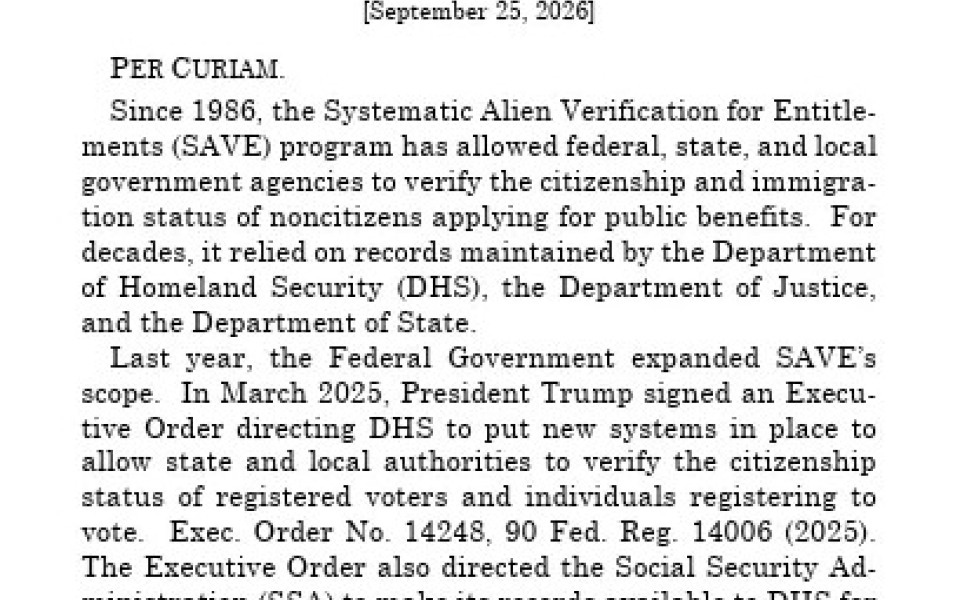
Yesterday, in a 6-3 majority opinion, SCOTUS cleared the way for states to use the Department of Homeland Security’s modified Systematic Alien Verification for Entitlements (SAVE) system to verify voter citizenship, staying a lower-court injunction that had blocked the expanded tool on privacy and statutory grounds. Justices Sotomayor, Kagan, and Jackson dissented.
The Court held that a 1996 federal law likely authorizes DHS to obtain citizenship information from other agencies despite federal privacy restrictions. The justices emphasized that the federal government has an obligation to respond to state and local election officials seeking to confirm citizenship. It also found the lower court's ruling interfered with lawful individualized voter checks, hindering proper election administration.
AG Todd Blanche said, “Huge victory for election integrity! The Supreme Court granted the Justice Dept’s stay in revamping the SAVE citizenship verification database, which will allow states to clear the voter rolls of illegal voters. The modified SAVE system allows state and local officials to conduct citizenship verification of registered voters to keep aliens from voting. The Justice Department will continue fighting in court for secure elections. Every American should want this!”
“This decision is a victory for election integrity,” said DHS General Counsel James Percival. “It’s remarkable that we had to file an emergency petition in the Supreme Court just so we can use government data to stop noncitizens from voting illegally. American elections are for Americans. The Trump Administration and the Department of Homeland Security will use every tool at our disposal to secure our elections.”
With SAVE, prosecutors also get a cleaner pipeline of illegals. Earlier this week, it was reported that DHS is investigating 1,620 cases of alleged voter fraud involving noncitizens casting ballots. The department has made 151 arrests and is reviewing 300,000 additional cases drawn from state voter rolls.
Because the National Voter Registration Act restricts systematic list-maintenance purges in the 90 days before a federal election, the immediate effect for the 2026 midterms is limited to case-by-case checks, but the restored tool will let current SAVE states resume important ongoing list maintenance.
After the election: Broader roll-maintenance using the modified system can resume under state law and existing SAVE agreements, unless a later court order changes the stay.
The stay is interim; the merits case continues. The underlying lawsuit, DHS v. League of Women Voters, remains on appeal in the D.C. Circuit. The loser can ask the Supreme Court for a full merits decision—likely after the midterms. A separate case, RNC v. Mi Familia Vota (set for Dec. 8, 2026), will address whether the NVRA’s 90-day ban applies to removals of alleged noncitizens.
But for now, yesterday’s ruling is a significant win for election integrity because it restores a practical federal mechanism to confirm that only U.S. citizens appear on voter rolls, helping ensure that American elections are reserved for American citizens and giving states a lawful way to identify and address ineligible registrations. Federal law already makes citizenship a clear eligibility rule for federal elections, and states cannot enforce that rule without usable data.
SAVE began in 1987 when the Immigration and Naturalization Service created an electronic verification service so federal, state, and local agencies could check immigration status before awarding public benefits and entitlements. Since then, more than a thousand agencies have used the program for licenses, benefits, and, beginning around 2005, voter-registration checks in some states.
President Trump’s March 2025 Executive Order 14248 directed DHS to give states free access to systems that help verify citizenship of both new registrants and existing voters. In response, DHS and USCIS integrated Social Security Administration records, added bulk-upload capability, enabled searches by Social Security number rather than only alien or naturalization numbers, and incorporated data that could confirm status for U.S.-born citizens who had never interacted with immigration authorities.
Those 2025 modifications transformed a benefits-focused lookup into a broader citizenship-verification tool available to election officials. SCOTUS also concluded Congress had already authorized that information-sharing architecture.
The system lets registered state and local election agencies submit an individual’s name, date of birth, and Social Security number (or other identifier), either one at a time or in bulk. SAVE then queries multiple federal record systems and returns an indication of citizenship or immigration status; a non-citizen or inconclusive result typically triggers further individualized review.
Officials in about 27 states currently use SAVE: Alabama, Arizona, Arkansas, Colorado, Florida, Georgia, Idaho, Indiana, Iowa, Kansas, Louisiana, Michigan, Mississippi, Missouri, Montana, Nebraska, North Carolina, North Dakota, Ohio, South Carolina, South Dakota, Tennessee, Texas, Utah, Virginia, West Virginia, and Wyoming.
Despite the June 22 nationwide injunction in DHS v. League of Women Voters, Florida, Iowa, Indiana, and Ohio had kept the SAVE expanded features under a separate court order, so the D.C. injunction did not stop their expanded access and follow-up work the way it did in other states.
The updated fee-free version gives SAVE states a faster, more complete way to flag potential non-citizens, confirm deaths, and keep rolls current, reducing the chance that ineligible voters remain on the books between election cycles.
The SCOTUS ruling restores a federal option for all 50 states and DC; it does not impose a national mandate. SAVE participation remains voluntary. A state must sign a memorandum of agreement with USCIS before election officials can query the SAVE system for voter registration or list maintenance purposes.
Washington is not among the participating states and does not require documentary proof of citizenship to register; it relies on its existing list-maintenance procedures (death records, inactivity, felony restoration, and other data matches) and has publicly resisted related federal requests for unredacted statewide voter files.
States that already use SAVE—or that choose to start—can now resume individualized citizenship checks and, after the 90-day pre-election window, broader list-maintenance work. States that decline, including Washington, continue to run elections under their own statutes and processes.
WHY CITIZENSHIP VERIFICATION IS CORE TO ELECTION INTEGRITY:
Federal law has long made it a crime for noncitizens to vote in federal elections. States run the voter rolls. If officials cannot reasonably check whether a registrant is a citizen, collateral impacts follow: ineligible registrants remain on the rolls, the likelihood of voter fraud increases, legal voters and citizens lose confidence that the elections are valid, and voter participation suffers.
Clean and accurate voter rolls reduce the chance that an ineligible ballot is counted, make prosecutions of actual violations more feasible, and give election offices a documented process instead of relying only on self-attestation or incomplete state DMV files. All of this helps to increase the public trust.
Of note: Recently, all three Franklin County, WA Commissioners and Auditor Matt Beaton have asked Secretary of State Steve Hobbs for written approval to check local voter registration records through the federal SAVE program.
In a letter discussed at the Sept. 16 commission meeting, county leaders said the request is meant to address concerns about voter-roll accuracy and to satisfy what they described as a duty under state law. They asked either for permission to run the check or for written proof that required citizenship screening has already been completed. The county asked Hobbs to respond within 10 business days. As of September 26, 2026 (today), the WA Secretary of State has still not responded.
The letter cited RCW 29A.08.125, which requires voter registration records to be screened against available government databases for issues including citizenship status, and a related provision allowing the secretary of state to work with other jurisdictions and federal agencies. Officials also requested written authorization under RCW 29A.84.150 so the county can use SAVE to verify its voter database.
They noted that if identity cannot be confirmed from records on file, state rules allow the auditor to use other government resources, public records, and direct contact with an applicant.
Franklin County pointed to a recent Pasco voter fraud case as one reason public concern has grown. A local apartment manager was convicted of submitting several forged ballots tied to former tenants from the 2024 general election and later sentenced to jail time, according to the Tri-City Herald and NBC.
Beaton said, “The goal of our request is to reassure the people of Franklin County of the integrity of the voter rolls. National polling on the topic is bipartisan and shows supermajority support for a common-sense review to assure integrity. We have worked cooperatively and respected the role of the Federal government in Washington state elections during my four terms in office.
Beaton added that Washington state has shared registered-voter data with ERIC, a private 501(c)(3), for more than a decade. “If that sharing was lawful, he said, Franklin County should be able to use comparable data to show the rolls are accurate.”
Share This Post...