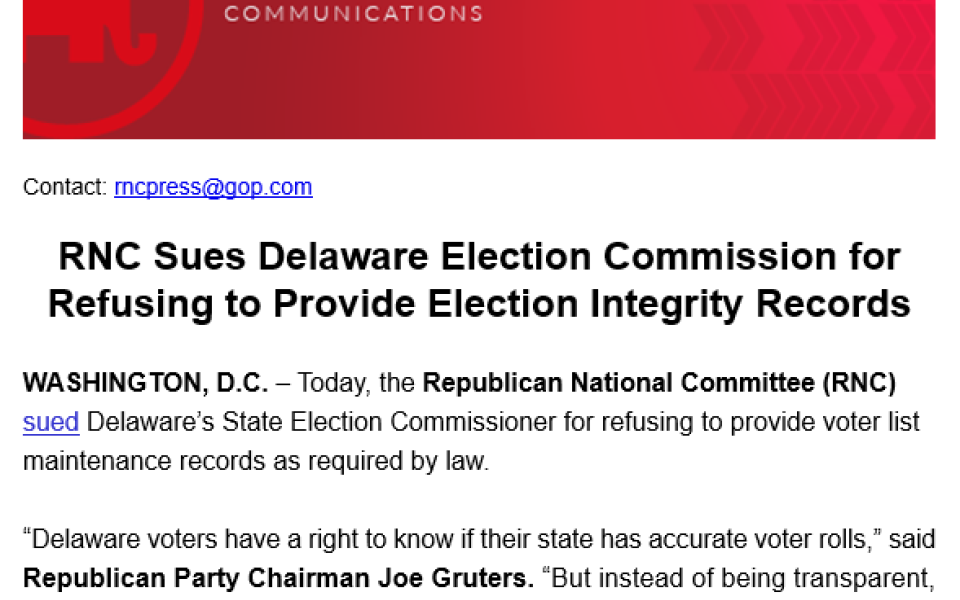
Yesterday, the Republican National Committee (RNC) filed a lawsuit against Delaware’s Election Commissioner for refusing to provide records of voter list maintenance required under the National Voter Registration Act (NVRA).
The complaint alleges that despite numerous attempts, Delaware failed to allow proper public inspection of documents detailing how the state removes ineligible voters—such as those who have died, moved, or been convicted of felonies—from its rolls. The suit contends that routine access to such voter roll records is essential for independent oversight, and seeks a court order compelling the production of maintenance records, including those covering removals and related activities over recent years.
The RNC argues that it has been harmed by inaccurate voter registration lists and by Delaware’s inability to confirm their accuracy. This lack of transparency violates federal mandates for accurate voter list maintenance and hinders efforts to verify compliance with election integrity standards.
Delaware officials have resisted detailed disclosures, often citing state privacy laws and concerns about releasing voter data.
Beyond Delaware, the RNC has pursued similar requests and legal challenges in several other states, including Arizona, New Jersey, Hawaii, Maryland, Nevada, Michigan, Montana, and others over alleged failures to maintain accurate lists, with mixed outcomes including voluntary dismissals or ongoing scrutiny.
In North Carolina, an earlier RNC suit against the NC Board of Elections concerning incomplete voter registrations for roughly 225,000 individuals was settled in February 2026, with the state agreeing to implement a Registration Repair Program (which involves contacting voters with incomplete records).
March 25, 2025, the RNC launched its largest-ever records requests related to state voter rolls. The RNC sent PRRs to the chief election officers of 48 states and DC. These requests sought documents and details on how states maintain their voter registration lists over the prior two years, including processes for identifying and removing ineligible voters (such as those who are deceased, have criminal convictions, have moved out of state, or are non-citizens).
These RNC lawsuits and PRRs closely parallel an ongoing effort by the U.S. Department of Justice Civil Rights Division, which is requesting that states release unredacted statewide voter registration lists per Federal Laws 52 U.S.C. 20701, 52 U.S.C. 20703, and 52 U.S.C 20507.
Currently, the DOJ has sued 29 states and DC for refusing to provide detailed registrant data—including driver’s license numbers and partial Social Security numbers. According to the lawsuits, the AG is uniquely charged by Congress with enforcing the National Voter Registration Act (NVRA) and the Help America Vote Act (HAVA), which were enacted to ensure that states have proper and effective voter registration and voter list maintenance programs. The AG also has the Civil Rights Act of 1960 (CRA) at their disposal to demand the production, inspection, and analysis of the statewide voter registration lists.
The DOJ’s campaign has achieved partial compliance through voluntary cooperation and a recent notable win in Oklahoma on March 24, 2026. AG Drummond entered a settlement on behalf of the State Election Board Secretary in response to the DOJ request for voter registration data.
In accordance with federal law, Oklahoma will provide the state’s computerized statewide voter registration list, as requested, through a settlement that ensures personal privacy protections.
“In Oklahoma, we are committed to the integrity of our elections,” Drummond said. “The State of Oklahoma will cooperate with efforts to eliminate voter fraud and safeguard electoral processes in accordance with the law. We are committed to both election integrity and the protection of personal information.”
According to the settlement, the DOJ will comply with the Privacy Act in handling and protecting the data. Additionally, the DOJ will use the copy of Oklahoma’s voter registration list to assess the State’s compliance with election laws, as requested.
“This settlement is a positive step forward for election integrity,” said AAG Harmeet Dhillon of the DOJ’s Civil Rights Division. “Clean voter rolls are essential for there to be confidence in our elections, and we commend Oklahoma for being a willing partner in that effort by producing the requested data.”
Drummond said that Oklahoma has strong election laws requiring proof of identity, notarization for most absentee voting, a ban on ballot harvesting, an Election-Day deadline for receipt of all absentee ballots, the use of paper ballots for all voters except those with disabilities, post-election audits to verify the accuracy of vote counts, and robust voter list maintenance practices.
At least 12 states- Alaska, Arkansas, Indiana, Kansas, Louisiana, Mississippi, Nebraska, Ohio, South Dakota, Tennessee, Texas, and Wyoming—have provided or committed to providing their full voter registration data to the DOJ.
AAG Dhillon has said her team found hundreds of thousands of dead voters & thousands of non-citizens on the rolls from the states that are complying - Also saying, “The government provides SSNs for voter registration verification. Any SOS hiding behind ‘protect your privacy’ claims is faking and doesn’t care about election integrity.”
Three federal district courts have dismissed DOJ’s lawsuits against California, Oregon, and Michigan. The DOJ has appealed all three decisions and has been granted review of the Michigan case in the Sixth Circuit Court of Appeals, with briefs due in the next few weeks.
Legal experts say the DOJ may be seeking a ruling from SCOTUS before the November 2026 midterm elections — and Michigan’s case, because it is moving through a faster appellate circuit, could reach it first.
The overlapping RNC and DOJ actions underscore a concerted call for greater transparency and maintenance of voter rolls under Trump’s March 2025 executive order on election integrity. The E.O. aims to prevent non-citizen voting, enforce federal government oversight, and ensure HAVA compliance.
Federal-state collaboration to maintain accurate voter rolls strengthens public confidence in elections by ensuring that only eligible voters are registered and that outdated or inaccurate records are removed.
Thank you, RNC and DOJ! States and Jurisdictions that lack basic transparency and refuse to clean and maintain their voter rolls are violating federal laws. They also disenfranchise lawful voters by eroding confidence in the election process and diluting their votes.
Share This Post...