Republicans Keep Redistricting Momentum But Expect More Lawfare...
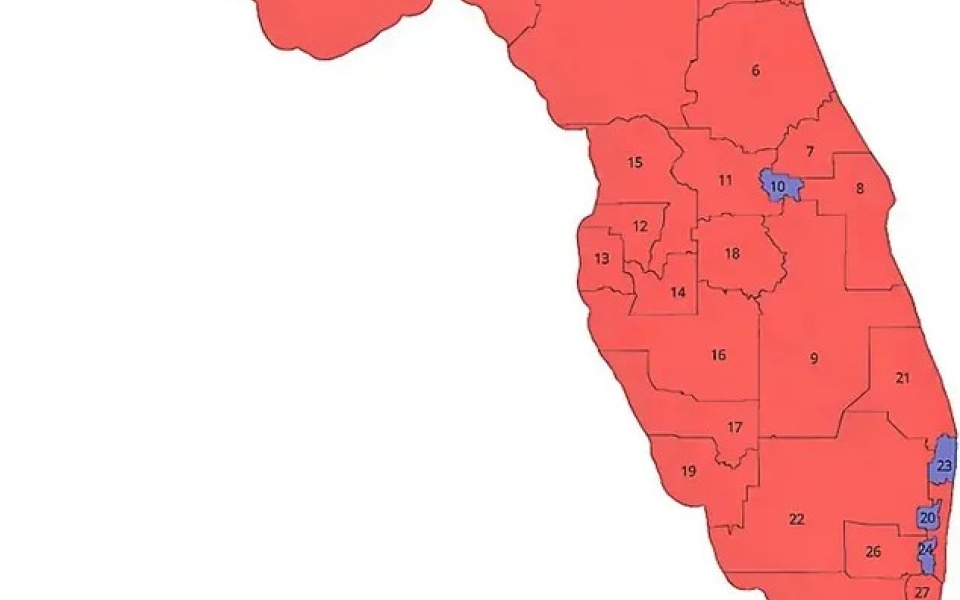
Yesterday, in an important ruling, a Florida circuit judge upheld FL’s new congressional map, soundly rejecting a lawsuit led by the leftist Elias Law Group. The court prioritized fair maps and election certainty with primaries looming, affirming the new map signed by Governor Ron DeSantis on May 4.
“The public interest weighs more in favor of certainty than a haphazard judicial mandate of discarded maps,” Leon County Judge Hawkes wrote.
This map shifts Florida’s Congressional delegation from a 20 (R) - 8 (D) split to a projected 24 (R) - 4 (D) advantage. The +4 gain reflects the state’s strong Republican voter-registration advantage and modern population realities, moving beyond outdated boundaries.
Florida argued that a combination of accounting for the change in state population since the 2020 U.S. Census, and the SCOTUS April 29 decision on Louisiana v. Callais, which ruled that race cannot be the predominant metric used in drawing congressional districts, was a factor in creating the congressional district map.
Florida’s population rose from about 21.538 million (April 1, 2020 Census) to roughly 23.463 million (July 1, 2025 estimate), for a net gain of ~1.925 million residents. This shift has been fueled initially by pandemic shifts, no state income tax, warm climate, and job opportunities as families and businesses escape from high tax, high inflation and high crime Democrat run hell hole states.
Republicans celebrated this as another defeat for partisan legal maneuvering, “Once again, we beat Marc Elias,” Fl AG James Uthmeier said, “Florida's new congressional district maps stand.”
Republican Party of Florida Chairman Evan Power issued the following statement:
“Gone are the days of snake-shaped districts. Florida’s maps are drawn fairly and reflect the makeup of our state. The truth is, Republicans hold a more than 1.5 million voter registration advantage in Florida, and our representation should reflect today’s Florida — not outdated, court-driven maps of the past.”
This victory underscores the importance of fair maps that reflect voters’ will rather than judicial or activist preferences, just in time for the 2026 FL primary elections. Elias backed groups have already filed a request for appellate review.
The case is moving to the Florida First District Court of Appeal, and is expected to reach the Florida Supreme Court for a final decision on whether the map violates the state’s Fair Districts Amendment (ban on partisan gerrymandering).
The map remains in effect for the 2026 elections unless a higher court issues a stay or injunction — which is considered unlikely on this short timeline due to the judge’s emphasis on election certainty.
Yesterday’s decision marks another GOP redistricting win through the courts. It follows the April 29 landmark SCOTUS 6-3 decision, Louisiana v. Callais, that struck down Louisiana’s racially gerrymandered congressional map, ruling that the Voting Rights Act (VRA) does not compel states to create additional majority-minority districts when race predominates over traditional districting principles.
And a May 8 landmark 4-3 ruling from the Virginia Supreme Court, which struck down a Democrat-proposed congressional gerrymandered map. The court found that legislators violated procedural requirements under the State Constitution when advancing the measure, nullifying the recent referendum election results, and reinstating the existing 2021 congressional maps.
That decision blocked a heavily gerrymandered plan that would have transformed Virginia’s delegation from a competitive 6D-5R split into a potential 10D-1R landslide, preserving multiple Republican-held seats in the state.
Across the nation, Republican-led states have capitalized on mid-decade opportunities to secure more accurate and competitive maps. Florida’s success joins the Republican red wave of wins: Texas enacted maps poised for substantial gains (+5 seats); North Carolina added +1 seat; Ohio +2 seats; Missouri +1 seat; and Tennessee +1 seat.
Ongoing Republican redistricting efforts in states like Georgia, Louisiana, and South Carolina could also add more potential future Congressional reps in 2028 where population and voting patterns warrant.
Yesterday in heavily Republican controlled Alabama, a 3 -judge federal panel blocked a 2023 state legislature approved map for the 2026 midterms, ruling it was “tainted by intentional race-based discrimination” and ordering continued use of the current 5 (R) - 2 (D) court-ordered remedial map (two Black districts).
The 2023 map was overwhelming supported in the legislature, with a vote of 25 to 7 in the State Senate and 76 - 26 in the State House - Almost entirely along party lines (ALL Republicans in favor, most Democrats opposed). This 6R–1D split was the standard outcome under that original map drawn by the legislature after the 2020 census.
Alabama Attorney General Steve Marshall appealed yesterday’s decision directly to the U.S. Supreme Court, which could rule quickly given the election timeline. If SCOTUS overturns the block, the state could still switch to the 2023 map (likely yielding a +1 gain to a 6R–1D delegation for the 2026 midterm elections.
The state is seeking an emergency stay or reversal so it can use the 2023 map (one majority-Black district) for the 2026 midterms. Marshall said the ruling is “disappointing but not surprising - This is a very fluid situation... Know this — in my mind, it is not a matter of whether we win this case, only when.”
GOP Gov. Kay Ivey said “I fully support AG Marshall appealing this unsurprising decision to the U.S. Supreme Court, and I remain hopeful they will allow Alabama to move forward with our August 11 Special Primary Election. I will continue to say: Alabama knows our state, our people and our districts best.”
Democrats have countered with their own map changes in states like Utah and California. However, CA’s “mapmaker” drew its new Congressional map with intentional racial goals, and to ensure “VRA seats are bolstered in order to make them most effective.” That’s illegal under Callais.
Last summer, CA Dems scrapped the nonpartisan Citizens Redistricting Commission’s map and replaced it with one drawn by a political consultant hired by the DCCC. The new maps would change CA representation from 43 (D) to 9 (R) to 48 (D) to 4 (R). However, this is far from over, as the Legislature had no evidence and no legal basis to sort millions of Californians by race.
Under the prior map, racial minorities were already electing 27 members of Congress. The new racial map changes boundaries in CA-01, CA-03, CA-22, CA-41, and CA-48 by gutting conservative-leaning counties to flip these 5 seats in this year’s 2026 midterm elections.
That led to a Nov 5 lawsuit filed by a coalition of CA Republicans seeking to block the map that voters passed as Proposition 50 in last year’s election. A few days later, the DOJ intervened on the plaintiffs' side. Then PILF filed a federal challenge in the U.S. District Court to CA’s Prop 50, saying it violates both the U.S. Constitution’s 15th Amendment and the VRA.
The complaint states CA Democrat legislators intentionally used race to redraw congressional districts – a clear violation of federal law, and under Callais!
If CA’s Prop 50 is nullified (e.g., via a successful court challenge deeming the map an unconstitutional racial gerrymander), then the prior voter-approved independent commission (CCRC) map will remain in effect.
ALSO, May 11, PILF filed the first lawsuit after the Louisiana v. Callais decision, against Governor J.B. Pritzker and the Illinois Board of Elections, challenging the Illinois Voting Rights Act of 2011. The lawsuit was filed in the U.S. District Court for the Central District of Illinois. In Illinois, Dems currently hold a 14D-3R advantage in the U.S. House.
“States may not use race to allocate power. Governor Pritzker explicitly adopted racial purposes behind redistricting guidelines, namely sorting and allocating political power based on race.” PILF President and General Counsel J. Christian Adams said.
As the first post-Callais state VRA challenge, a victory would reinforce the Supreme Court’s limits on race in redistricting. This helps Republicans in other states fighting similar provisions or defending their own maps. It could strike down race-mandated provisions, meaning future maps must prioritize traditional criteria over racial targets.
Democrats have been gerrymandering states’ congressional maps for decades, maxing out their potential. E.g., New England Democrats control ALL 21 House seats spread across six states (not a single GOP representative). It is estimated that if both parties MAXXED OUT on gerrymandering, the U.S. Congress would end up with 262 Republicans to 173 Democrats.
The current party breakdown in the House is 217 (R) to 212 (D), with 5 vacant seats. Most often, the party not holding the Presidency does better in midterm elections, with a few exceptions, including Dems picking up House seats in 1998 and the GOP in 2002.
The latest Cook Political Report rates 210 seats as leaning Republican or likely R wins in November, to the Ds’ 207, leaving 18 toss-ups (14 held by the GOP and 4 by the Dems).
Share This Post...