SCOTUS Faces Dual Emergency Requests on Mail-Voting Executive Order
Today, twelve Republican-led states asked the Supreme Court to stay a lower-court injunction blocking key parts of President Trump’s March 2026 election-integrity Executive Order 14399 ENSURING CITIZENSHIP VERIFICATION AND INTEGRITY IN FEDERAL ELECTIONS, joining a parallel emergency request the administration filed Monday. The E.O. directs the Department of Homeland Security to compile state-by-state citizenship lists of voting-age residents and instructs the U.S. Postal Service to adopt new rules limiting mail-ballot delivery to people on approved lists.
June 25, 2026, a federal judge in Massachusetts (California et al. v. Trump) blocked key EO provisions for 23 Democrat-led states and D.C. ahead of the midterms. There, Judge Indira Talwani held that Sections 2 (DHS citizenship lists) and 3 (USPS rulemaking on mail ballots) of the EO are ultra vires (beyond authority) and unconstitutional, and she enjoined federal agencies from implementing them in the 23 plaintiff states + D.C. for the 2026 elections. Then on Saturday, in a 2-1 decision, the 1st U.S. Circuit Court of Appeals denied the DOJ request to pause that ruling.
On Monday, the DOJ, via Solicitor General D. John Sauer, sought an immediate stay in Trump v. California, contending the district court acted too soon while agencies are still deliberating and that relief is needed so any rules can take effect in time for November. “The executive order is an intra-branch directive from the president to his subordinates — which, of its own force, does not change anything at all about elections in any state,” Sauer told the Supreme Court in the appeal. “It does not require the states to do (or refrain from doing) anything at all.”
In its appeal to the Supreme Court on Monday, the administration framed its executive order as “general policy guidance” and stressed that the Postal Service had not finalized any regulations. The administration asked for an immediate “administrative” order to put the lower court decisions on hold.
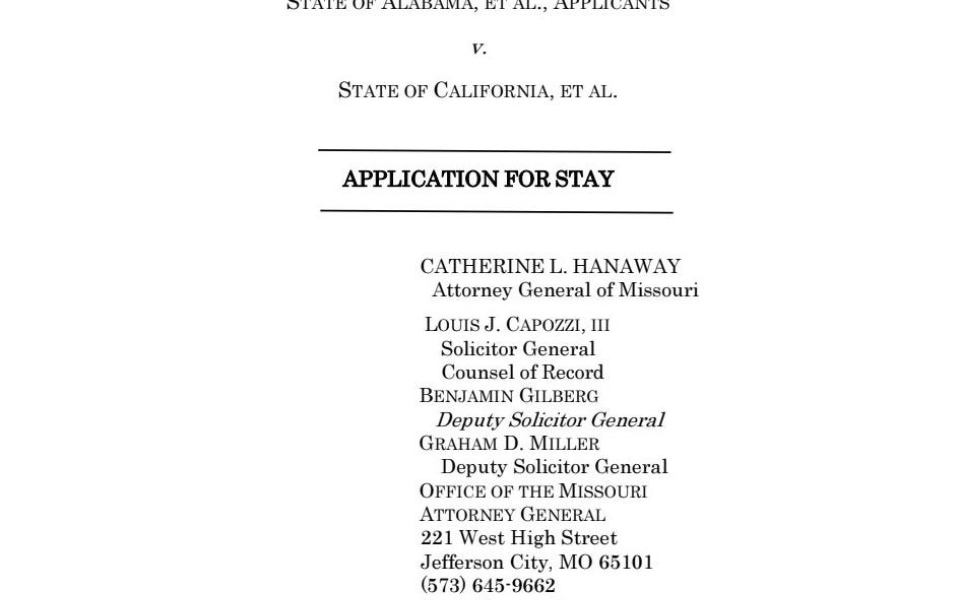
The 12 GOP intervenors—Alabama, Florida, Indiana, Kansas, Louisiana, Missouri, Montana, Nebraska, Oklahoma, South Carolina, South Dakota, and Texas—argue the challenge is premature, the injunction improperly halts non-self-executing directives, and are asking SCOTUS to restore key parts of the election integrity executive order that direct DHS to compile citizenship lists and USPS to adopt new mail-ballot security rules. The application is signed under Missouri Attorney General Catherine L. Hanaway. Louis J. Capozzi III, Solicitor General of Missouri, is the counsel of record.
The two emergency application filings target the same injunction in the same underlying lawsuit (California et al. v. Trump). The pending SCOTUS stay requests seek to lift it so the EO provisions (and the related USPS rulemaking) can proceed while the appeal continues. Both filings make overlapping standing and ripeness arguments and urge the Court to curb what they call a trend of preemptive injunctions against executive orders.
Justice Ketanji Brown Jackson has ordered the plaintiff states to respond to both applications by 4 p.m. EDT on Monday, August 3. After that filing, the Supreme Court is expected to rule promptly on the stay requests—potentially within days or a couple of weeks—given the midterm timeline and the administration’s argument that implementation steps must begin in early-to-mid August. A grant would allow the challenged provisions to proceed in the affected jurisdictions while the First Circuit appeal continues; a denial would keep the injunction in place for the 2026 election cycle.
Meanwhile, in a parallel related case, yesterday the US Court of Appeals for the DC Circuit upheld a lower court ruling, temporarily clearing the way for the E.O. and for USPS to keep working to advance its proposed election-mail rule.
A three-judge panel (Judges Millett, Wilkins, and Katsas) of the U.S. Court of Appeals for the D.C. Circuit affirmed the district court’s May 28, 2026 order denying a preliminary injunction sought by the DSCC and other Democrat Party entities against key parts of E.O. 14399 (on citizenship verification lists via federal databases and related Postal Service rules for mail ballots).
The D.C. Circuit ruling is a solid procedural win for the Trump administration. It keeps the door open for agencies to continue developing the citizenship lists and the USPS rulemaking process in the face of the Democrats’ lawsuits. However, it does not:
Decide whether the executive order is lawful on the merits
Lift the broader injunction that still blocks key parts of the order in 23 states + D.C. (the multi-state case now at the Supreme Court for a stay request)
Create any final, binding USPS rule that states must follow
Change the practical status quo for the 2026 midterms in any major way
The underlying district-court case continues; plaintiffs can try again for an injunction if concrete agency actions occur, and the bigger legal fights now are at SCOTUS.
Mail-in voting has exposed serious vulnerabilities that threaten the integrity of U.S. elections. Unlike in-person voting—with its real-time identity checks and immediate tabulation—mail-in ballots travel through unsecured channels where opportunities for fraud, manipulation, and error multiply over the course of the election season.
Until mail-in voting is banned, the E.O. and USPS rule is an improvement!
Of Note: Last month, in the 2026 presidential election, Colombia hand-counted 99.8% of its 25+ million ballots in under 3 hours. Very minimal mail-in voting. Paper ballots. Photo ID required. Counted on-site at the polling tables right in front of witnesses and party observers. Results basically done the same night. Let’s hope all the U.S. states can get back to this someday…
In the meantime, be advised: If you witness suspicious activity, mail theft, ballot tampering, or any potential criminal issue involving election mail, report it to the U.S. Postal Inspection Service National Law Enforcement Control Center, 877-876-2455.
Election integrity depends on the secure handling of every lawful ballot. These proposed USPS changes represent good reforms, using proven technology to modernize mail ballot handling without restricting eligible voters’ access. A more secure mail-in system strengthens confidence in elections for all Americans.
Share This Post...